
What Bees See: Understanding Bee Vision & Color Detection.
Bees experience the world very differently from humans do. While people rely heavily on shape and color within the visible spectrum, bees use a unique visual system that allows them to see patterns, colors, and signals that are completely invisible to us. Understanding what bees see helps explain how they find flowers, navigate long distances, and survive as one of nature’s most important pollinators.
For homeowners and nature lovers alike, learning about bee vision also builds appreciation for why bees behave the way they do—why they return to the same spot, why they’re drawn to certain colors, and how they locate food with such precision.
This guide explains bee vision in simple terms, without scientific confusion, so anyone can understand how bees truly see the world.
How Bee Vision Is Different From Human Vision
Humans have three types of color receptors in their eyes that allow us to see red, green, and blue. Bees also have three color receptors, but theirs are tuned very differently. Instead of red, bees can see ultraviolet (UV), blue, and green light.
This difference means that bees do not perceive the color red in the same way humans do. In fact, red flowers often appear black or dark to bees. However, what bees lack in red vision, they make up for with their ability to see ultraviolet patterns—something completely invisible to the human eye.
These ultraviolet patterns resemble glowing landing lights on flowers, guiding bees directly to nectar and pollen.
Ultraviolet Vision: The Hidden World Bees Can See
One of the most fascinating aspects of bee vision is ultraviolet detection. Many flowers have UV markings that serve as natural road signs for bees. These markings point directly to the nectar source, helping bees collect food efficiently.
To humans, a flower may look like a single solid color. To bees, that same flower may display bold UV patterns, contrasting rings, or arrows leading inward. This ability gives bees a major survival advantage and makes pollination more accurate.

Bee vision reveals ultraviolet patterns invisible to the human eye.
Ultraviolet vision also helps bees:
Identify healthy flowers
Detect fresh nectar sources
Distinguish between similar-looking plants
Avoid flowers that have already been visited
How Bees See Color
Bees are most attracted to blue, violet, and yellow flowers. These colors stand out clearly in their visual spectrum. Purple flowers are especially appealing because they often reflect ultraviolet light, making them highly visible to bees.
Common flower colors bees love include:
Blue
Purple
Violet
Yellow
White with UV markings
Because bees cannot see red well, red flowers often rely on scent rather than color to attract pollinators.
This color preference explains why gardens filled with blue and purple flowers attract more bees than gardens dominated by red blooms.
Do Bees See Shapes and Patterns?
Yes, bees are excellent at recognizing shapes and patterns. While their eyesight is not sharp in the same way human vision is, bees excel at detecting movement, contrast, and symmetry.
Bees can:
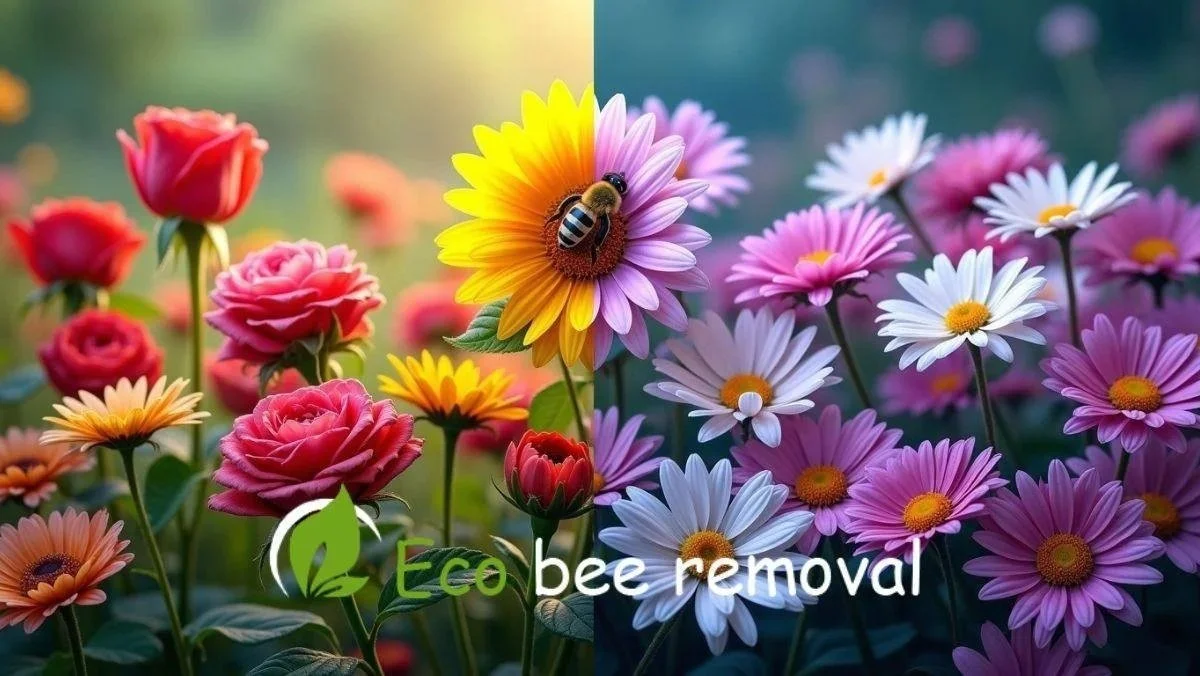
A visual comparison of how bees and humans see flower colors differently.
Recognize circular and radial patterns
Identify flower shapes
Learn visual landmarks
Remember patterns linked to food sources
This ability allows bees to return to the same flowers repeatedly and even recognize the entrance to their hive among many similar structures.
How Far Can Bees See?
Bees do not see long distances clearly, but they are extremely good at detecting movement and color changes from afar. Flowers that reflect UV light or contrast strongly with their surroundings are easier for bees to spot.
Once closer to a flower, bees rely on fine visual details, scent, and memory to locate nectar efficiently.
This combination of short-range detail vision and long-range color detection makes bees incredibly effective pollinators.
Bee Vision and Navigation
Bees don’t just use vision to find flowers—they use it to navigate entire landscapes. Bees rely on the sun’s position, polarized light patterns in the sky, and visual landmarks to find their way home.
Even on cloudy days, bees can detect polarized light invisible to humans, allowing them to stay oriented. This natural navigation system helps bees travel miles away from their hive and return safely.
This is also why bees may repeatedly visit the same wall, tree, or structure—once they visually map an area, they remember it well.
Can Bees See in the Dark?
Bees cannot see well in complete darkness, but some species can function in low-light conditions. Early morning and late evening foraging is possible due to their sensitivity to light and motion.
However, bees rely more on scent and memory than vision when light levels are low.
How Bee Vision Affects Their Behavior Around Homes
Understanding what bees see helps explain why they are sometimes attracted to homes, walls, or structures. Certain surfaces reflect light in ways that resemble natural shelter or flowers.
Bright colors, strong contrasts, and reflective materials can draw bee attention. Once bees find a suitable location, their strong visual memory keeps them returning.
This behavior highlights why professional bee removal and relocation are important. Bees are not aggressive by nature—they are simply responding to visual and environmental cues.
Why Bee Vision Matters for Pollination and the Environment

Bee using vision and sunlight to navigate toward flowers.
Bee vision plays a crucial role in pollination. Their ability to see ultraviolet patterns ensures that pollen is transferred efficiently between plants. This supports:
Healthy ecosystems
Crop production
Biodiversity
Food security
Without bees and their advanced vision, many plants would struggle to reproduce.
Seeing the World Through a Bee’s Eyes
When we ask what bees see, the answer reveals an entirely different version of reality—one filled with ultraviolet signals, glowing patterns, and visual cues we cannot perceive. Bee vision is perfectly adapted for survival and pollination, making bees one of nature’s most efficient workers.
By understanding bee eyesight and color detection, we gain respect for their behavior and importance. Protecting bees means protecting the delicate visual world they depend on—and ultimately, protecting our environment as well.
If you ever notice bees repeatedly visiting the same area, remember: they’re not just seeing what you see. They’re seeing a hidden world that guides every move they make.